|
|
Themes
Heraldico
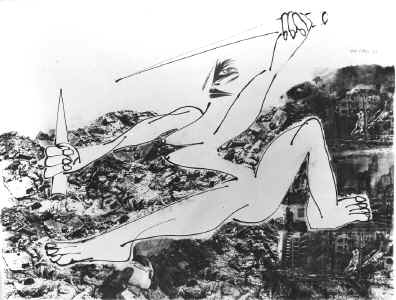
De strijder, 1993
Phototransfer and ink on paper, 50x65 cm
Reference: 935005
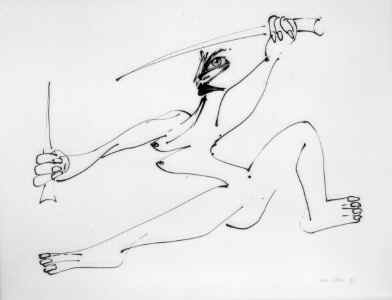
Amazone, 1993
Photocollage and ink on paper, 50x65 cm
Reference: 935007

Belphoebe, 1997
Oil and acrylic on cotton, 150x200 cm
Reference: 972002
Based on text of Edmund Spenser
La reina de las hadas. La primera parte se
publicó en 1590 y la segunda parte en 1596. Es un texto de
carácter alegórico, escrito para alabar a Isabel I.
Enmarcado en la estrofa distintiva y opulenta de Spenser y en algunos de los
adornos de la épica, el libro uno de La reina de las hadas de Spenser consiste
en un romance caballeresco que se ha hecho con una receta típica: guerras
feroces y amores fieles, pero que ha sido cristianizado. tanto de forma abierta
como sutil. Los vagabundeos físicos y morales del Caballero de la Cruz Roja
dramatizan su esfuerzo por encontrar la proporción adecuada de contribuciones
humanas y divinas a la salvación, un tema clave entre protestantes y católicos.
Elementos fantásticos como humanos alienígenas, humanoides y monstruos y sus
respectivos lugares de residencia se describen vívidamente.
Framed in Spenser's distinctive, opulent stanza
and in some of the trappings of epic, Book One of Spenser's The Faerie Queene
consists of a chivalric romance that has been made to a typical recipe--fierce
warres and faithfull loves--but that has been Christianized in both overt and
subtle ways. The physical and moral wanderings of the Redcrosse Knight dramatize
his effort to find the proper proportion of human to divine contributions to
salvation--a key issue between Protestants and Catholics. Fantastic elements
like alien humans, humanoids, and monsters and their respective dwelling places
are vividly described.
The Apollonian
Androgyne and the Faerie Queene - by Camille Paglia
THE Faerie Queene
contains literature's greatest epiphanies of what I call the Apollonian
androgyne, the angel, the radiant figure of precise contours, glittering
chastity of form, and unitary, centripetal energies. The armed Amazons Belphoebe
and Britomart express their radical autonomy in a blaze of self-generated light,
a light like that of the Olympian gods in their function as representatives of
the social order,1 and like that popular notion of "glamour" in which
Kenneth Burke has rightly seen "a hiërarchie motive."2 This is the
light of the daytime world of law, in which all the great actions of the
Faerie Queene occur: here shade and half-light represent the fading or
slackening of the moral will. The Dionysian androgyne of darkness and
sensuality, with its characteristic subversion of the principium
individuationis, is abhorrent to Spenser because in his poem the integrity
of forms of every kind and also the distinctness of their visual apprehension
are obsessively insisted upon.
The armor worn by many
of Spenser's virtuous characters in their testing
and self-purgation is part of a system of imagery which conceives of personality
as discrete and indissoluble, cohesive and luminous. Jane Harrison remarks,
"Apollo is the principle of simplicity, unity, and purity, Dionysos of manifold
change and metamorphosis."3 In a passage which is the ultimate source
of Nietzsche's terminology in The Birth ofTragedy, Plutarch describes
Apollo as being in overt opposition to the Dionysian, "denying the Many and
abjuring multiplicity."
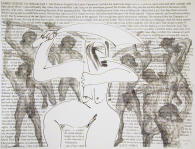
Britomart, 1997
Ink and printer ink on paper, 50x65 cm
Note: Text of the Faerie Queene, Edmund Spenser
Reference: 975016
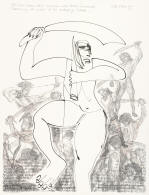
All in her snow-white smocke, 1997
Ink and printer ink on paper, 65x50 cm
Reference: 975017
Where feeling one close couched by her side,
She lightly lept out of her filed bed,
And to her weapon ran in minde to gride
The loathed leachour. But the Dame halfe ded
Through suddein feare and ghastly drerihed,
Did shrieke alowd, that through the house it rong,
And the whole familv therewith adred,
And to the troubled chamber all in armes did throng.
And those six Knights that Ladies Champions,
And eke the Redcrosse knight ran to the stownd,
Halfe armd and halfe vnarmd, with themattons:
Where when confusedly they came, they fownd
Their Lady lying on the sencelesse grownd;
On th'other side, they saw the warlike Mayd
All in her snow-white smocke, with locks vnbownd,
Threatning the point of her auenging blade.
That with so troublous terrour they were all dismayde.
Whom seeing flie, she speedily poursewed
With winged feete, as nimble as the winde,
And euer in her bow she ready shewed
The arrow, to his deadly marke desynde.
As when Lalonaes daughter cruell kynde,
In vengement of her mothers great disgrace,
With fell despight her cruell arrowes tynde
Gainst wofull Niobes vnhappy race,
That all the gods did mone her miserable case.
So well she sped her and so far she ventred,
That ere vnto his hellish den he raught,
Euen as he ready was there to haue entred,
She sent an arrow forth with mighty draught,
That in the verv dore him ouercaught,
And in his nape arriuing, through it thrild
Hisgreedy throte, therewith in two distraught,
That all his vitall spirites therebv spild,
And all his hairy brest with gory bloud was fild.
Edmund Spenser, The Faerie Queene
Index 1985
|
