|
Jan van Eden
bio - biography Nederlandse ontwikkelingshulp in
Zambia-vanaf 1966
Een persoonlijke samenvatting en commentaar op
ontwikkelingshulp
Mijn aankomst in Zambia aan het
einde van het jaar 1967 was 3 jaar na de onafhankelijkheid. Het sociale
bestel van Zambia zal niet veel anders zijn geweest dan
in de laatste koloniale dagen onder de Engelsen. Maar de Zambiaanse
regering onder president Kaunda had de koperindustry genationaliseerd en de
bevolking was zich wel bewust van de onafhankelijkheid. Het was voor ons,
expatriats, die de noodzakelijke technische kennis meebrachten, een
paradijs. Wij hadden wel privileges zoals relatief hoge inkomens en
behuizing in moderne villas, maar het sociale bestel werd geaccepteerd door
de zwarte bevolking, waar we mee in contact kwamen binnen de kaders van ons
werk. De veiligheid in de straat was zo goed dat we geen sleutel nodig
hadden voor ons huis.
Vier jaar in het land en we hebben nooit
iemand ontmoet van de organisaties in de ontwikkelingshulp. Deze
organisaties werkten in de armere gebieden van Zambia en niet in de
welvarende Copperbelt mijnbouwgebieden. Mijn informatie is gebaseerd op
berichten in de recente pers en internet.
Een goed overzicht word gegeven door
African Studies Centre
From idealism to realism
A social history of the Dutch in Zambia
1965 tot 2013
Anne‐Lot Hoek
Technical assistance in the form of young
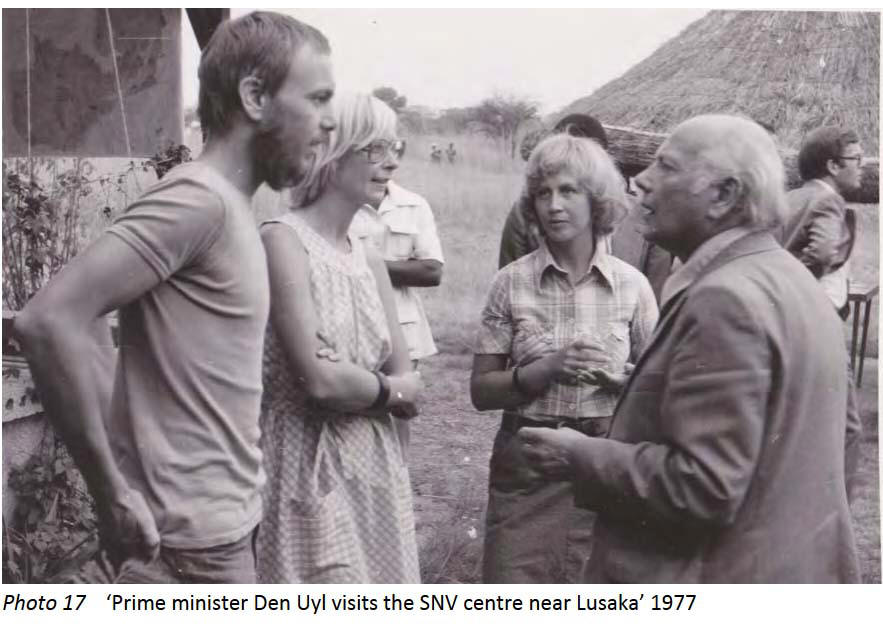
volunteers formed the initial face of Dutch development aid in Zambia. The
first team of nine Dutch volunteers of the Youth Volunteer Programme (JVP)
arrived in 1966. The organization behind the JVP, SNV (Stichting Nederlandse
Vrijwilligers), focused its policy on ‘integrated rural development’,
supplying agricultural, health, and educational services to specific areas.
Dutch development assistance was clearly aimed at the level of poor
subsistence farmers, following its ideal of reducing regional welfare
inequalities. By contrast, organizations like the EU and World Bank
supported the provinces with greater potential.
Volunteers received a three‐month course of
very basic training from the Royal Tropical Institute in Amsterdam. In
general, the focus of the volunteer programme was based on the idea that the
recipient country ‘had to be changed’. Local culture, therefore, was seen as
a hindrance. In the publicity films, shown to volunteers during their
training, it was suggested that local methods of milking, ploughing and
preparing food were all ‘wrong’. It was clear from the start, therefore,
that Western perspectives on what development entailed prevailed in the aid
relationship. In line with this perspective, the Dutch ambassador saw
development as the important task of transferring knowledge with the goal of
making oneself superfluous:
The Dutch integrated very well with the
Zambians. There was no discrimination; they were morally good people.
The Zambians were very happy with their arrival. They were doing things here
with chickens and trees and agriculture. A Dutch couple – Max and Tineke –
taught people how to produce rice. Before their arrival there was no rice
here; the project was very successful. Tineke made uniforms for children in
the area, and she taught women how to make them.
According to volunteers, however, most
Zambians did not see much difference between them and the former colonizers.
Volunteers in numerous cases replaced colonial teachers and nurses, who had
lost their jobs at independence, and had the same lifestyles. A former
volunteer observed: “For Zambians there wasn’t much difference between us
and the former colonials. If you arrive there as a young bloke, drive a Land
Rover, and you can buy whatever you want, do whatever you want, and somebody
was cooking and cleaning for you, it didn’t matter to the local population
who you were. You were just another white one.” This large gap between
two different worlds is also found in the feelings of the volunteers when
they look back on their experiences. Many Dutch feel their time as
volunteers was, though very exciting and valuable, mainly beneficial to
themselves and not so much to the people.
Other sources of information
Former ambassador Graaf Van Limburg Stirum,
who took office in 1978, underlines that local practice did not lead in
Dutch development policy because “the Dutch were determined to pursue their
own plans about what they thought was important for Zambians”. We knew
better. That was a typically Dutch type of behaviour at that time. Officials
from The Hague came yearly to Zambia to dictate the Dutch development
policy. The Zambians just accepted it. A good example is the request of the
Zambian government for the Dutch to assist them with setting up a transport
system together with Dutch transport company DAF. The Dutch refused, because
it didn’t fit into their own development priorities.”
Its status as a Least Developed Country was
changed to a Lower Middle Income Country by the World Bank in 2012: a
landmark in Zambia’s decade of economic growth. According to the same bank,
Zambia is today a “fast‐growing economy”. Despite the economic growth, de
velopment challenges are still prominent. Approximately 60 per cent of the
population continues to live below the poverty line. The United Nations
Human Development Index ranked 185 UN member states in 2012 according to
their development level; Zambia held position 163, lower than Angola,
Madagascar, Uganda, and Lesotho. In fact, Zambia had climbed only three
places since 1980.
In de jaren rond 2000 waren er verscheidene
projecten die een positieve ontwikkeling hadden.
Mark Terken (1965 - 2018)
kwam in 1991 als stagiair tropische landbouw naar Zambia. nu werkt hij in
heel afrika als adviseur voor groene investeerders.
Na zijn stage begon Mark Terken een bedrijf dat paprika’s exporteert.
Hij kreeg subsidie van verschillende ontwikkelingsorganisaties. Ook kon hij
daarmee boeren trainen en ze helpen bij het kopen van
landbouwchemicaliën. “De Nederlandse initiatieven die in Zambia zijn
gebleven, onderscheiden zich doordat ze bedrijvigheid stimuleren”, zegt
Terken, die tegenwoordig grote buitenlandse investeerders, fondsen en banken
adviseert op het gebied van duurzame landbouwinvesteringen.
Hij heeft voor de Wereldbank net veertien grote landbouwbedrijven in vier
Afrikaanse landen, waaronder Zambia, onderzocht op hun maatschappelijke
verantwoordelijkheid. “Afrika en landbouw zijn hot, er is veel
geld beschikbaar om te investeren en de ontwikkelingsimpact die daarmee
behaald kan worden is, ondanks de uitdagingen, groot.”
Nederlandse boerenbedrijven in Zambia zijn volgens Terken een voorbeeld van
die positieve invloed. “Kijk naar het bedrijf van Willem Lublinkhof. Zijn
koffie wordt duurzaam verbouwd, hij zorgt voor duizenden banen en draagt
zorg voor zijn werknemers en hun gezin. Dat is een blijvende Nederlandse
bijdrage aan de ontwikkeling van Zambia waarop we best trots mogen zijn.”
Volkskrant:
11 feb 2013 — Zambia verliest drie keer zoveel geld door
belastingontwijking dan dat het binnenkrijgt via ontwikkelingshulp,
is de schatting van ActionAid. Er word verwezen naar een grote
suikercompany, werkzaam in Zambia, met brievenbus adres in Nederland.
Mining in Zambia-70s&80s
| 